
Plato The Greek Philosopher of the Soul
Beyond Shadows
The Soul Facing the Wall
Imagine you have never seen the sun.
You were born facing a wall.
All your life, shadows have moved before your eyes, and because no one told you otherwise, you believed the shadows were the world.
Then one day, something changes.
You turn.
At first, the light hurts. Truth is not always gentle. The soul resists what it does not yet understand.
But slowly, painfully, the world becomes larger than the wall.
For Plato, this was not only a story about knowledge.
It was a story about the soul.
Athens in a Time of Questions
Around 427 to 347 BCE
Plato lived in Athens from around 427 to 347 BCE, during the classical period of ancient Greece.
He was born into a city of beauty and conflict. Athens had temples, theater, poetry, public debate, political ambition, and war.
It was a city where citizens argued about justice, power, truth, virtue, and the kind of life a human being should live.
But Plato did not grow in a peaceful age.
His youth unfolded in the shadow of the Peloponnesian War, the long conflict between Athens and Sparta.
He saw how quickly a city of wisdom could become a city of fear, pride, division, and violence.
From the beginning, Plato’s philosophy was not separate from life.
It was born inside history.
Socrates and the Wound of Truth
399 BCE
Then came Socrates.
Socrates was not a teacher in the ordinary sense. He did not simply give answers.
He asked questions.
He challenged certainty.
He invited people to examine their lives, their beliefs, their justice, their courage, and their soul.
For Plato, Socrates became the living image of a person devoted to truth.
But in 399 BCE, Athens condemned Socrates to death.
This moment changed Plato.
The death of Socrates was more than the loss of a teacher. It was a wound in the heart of philosophy.
How could a city mistake wisdom for danger?
How could public opinion condemn a man whose life was dedicated to the examined life?
From that wound, Plato began to ask deeper questions.
Do human beings truly see reality?
Do they love truth, or only approval?
Can the soul rise beyond fear, habit, desire, and the noise of the crowd?
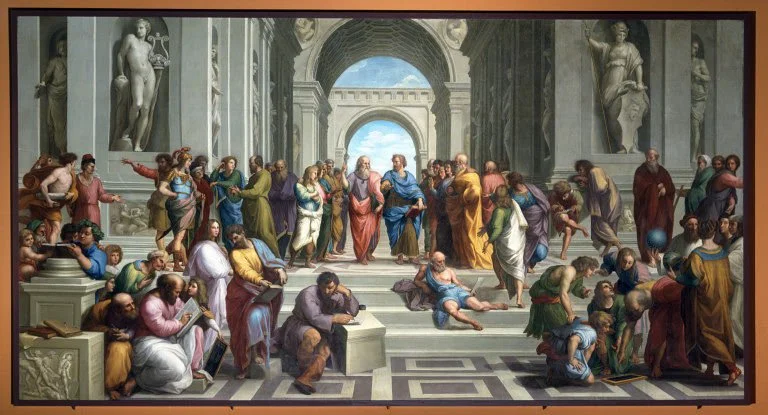
Raphael’s The School of Athens presents a gathering of ancient philosophers, mathematicians, and seekers of wisdom inside an ideal classical hall. At the center, Plato and Aristotle walk side by side, symbolizing two great paths of thought: the world of ideas and the world of experience.
The Academy and the Turning of the Soul
Around 387 BCE
Around 387 BCE, Plato founded the Academy in Athens, one of the earliest known centers of philosophical learning in the Western world.
There, philosophy became a path of formation.
For Plato, learning was not only the collection of information.
It was the shaping of the soul.
A human being had to be turned toward truth, goodness, beauty, and wisdom.
This is why the image of the cave became so powerful.
In the cave, people mistake shadows for reality because shadows are all they have ever known.
To leave the cave is difficult.
The light wounds the eyes.
The familiar world disappears.
The soul must learn how to see again.
The Soul Turning Toward Light
This is where philosophy becomes human.
For Plato, the soul was not meant to remain still. It was meant to turn away from illusion, away from fear, away from the shadows that make life smaller than it truly is.
Every act of courage, forgiveness, caregiving, resilience, healing, devotion, or generosity is also a kind of turning.
A turning away from indifference.
A turning away from fear.
A turning away from the voice that says nothing can change.
An everyday hero may never speak like a philosopher.
But through action, they reveal a soul moving toward something greater than comfort.
They choose love when it is difficult.
They choose responsibility when it is heavy.
They choose light when the world offers shadow.
And in that turning, the soul becomes visible.